



Comparing Food Packaging Equipment for Diverse Food Products
April 2025
In food packaging automation, one size rarely fits all. Every product — from delicate pastries to moisture-rich poultry — presents unique challenges when it comes to wrapping, sealing, and presentation. That’s why Omori doesn’t just sell food packaging equipment; we engineer solutions tailored to the specific needs of your products, your facility, and your production goals.
Why Customization Matters
Mass-market packaging equipment often struggles with the variety and complexity of today’s food products. For high-volume operations, even minor inefficiencies — misaligned seals, product shifting, or inconsistent wrapping — can lead to product waste, downtime, and lost revenue. Customization is the key to overcoming these challenges.
Omori: Engineered for Product Variety
Whether you’re packaging shapely fresh produce, frozen entrees, or temperature-sensitive proteins, Omori designs food packaging automation systems that meet your product’s needs:
- Optional Moisture Control: Our flow wrappers and end-seal machines can be adapted to manage condensation, keeping both the film and the seal area clear for high-quality results.
- Delicate Handling: For fragile or irregularly shaped products, we offer specialized infeed systems, like Omori’s lug infeed, to ensure smooth, accurate placement without damaging the product.
- Size Flexibility: From wide-entry to high-belt, our machines are configurable to handle a wide range of dimensions and tray styles with quick-change tooling and programmable settings.
Your Food Packaging Solved with Omori’s Food Packaging Products
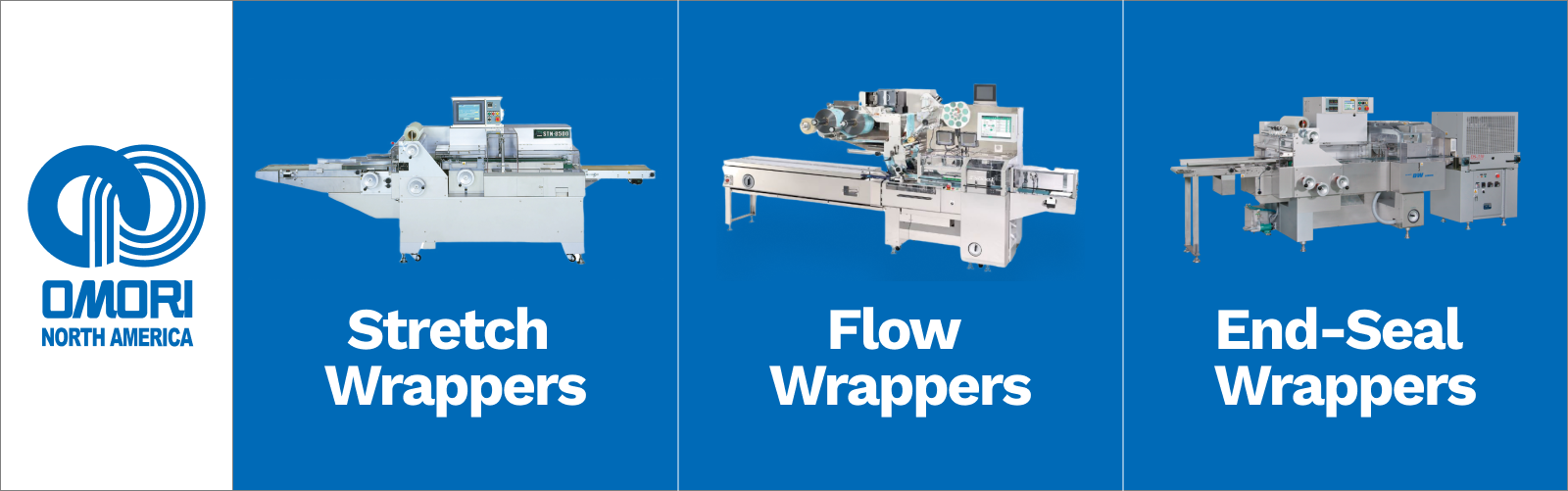
Check out our guide on whether your application calls for an Omori Stretch Wrapper, Flow Wrapper, or End-Seal Wrapper:

Food Packaging Equipment Tailored for Your Operation
Beyond product type, every facility has its own layout, throughput requirements, and workflow. Omori works directly with your engineering team to develop a packaging system that:
- Fits your line — whether you need a standalone unit or seamless integration.
- Meets your throughput targets without over-engineering.
- Includes user-friendly interfaces, wash-down capabilities, and easy-maintenance designs.
Built for Today, Ready for Tomorrow
Omori equipment is built to evolve with your operation. As your product offerings expand or regulations shift, we can adapt your machine settings, film compatibility, or mechanical components to keep you competitive and compliant.
Diverse products shouldn’t mean difficult packaging. Work with Omori and you’ll get a custom-fit solution engineered for efficiency, consistency, and growth.
Contact Us
Have questions? Our team of customer care experts are standing by to help craft an efficient solution for your business. Complete the form below and an Omori representative will be in touch.
U.S. Facility
775 Atlanta South Parkway
Suite 300
College Park, GA
30349
Local: 770-913-7883
Canada Facility
28 Simpson Rd
Bolton, ON
L7E 1G9
Local: 905-857-7880
Toll Free: 1-888-379-4742
CONTACT SALES
CONTACT PARTS
CONTACT SERVICE
CONTACT CUSTOMER SERVICE
August 2026
Most food processors and manufacturers rely on a simple manual step for padding trays before packaging meats, proteins, fruits, vegetables, etc. While this process appears straightforward, it introduces hidden costs that often go unnoticed across the packaging operation
As production demands increase and consistency becomes more critical, many processors are discovering that manual tray preparation can quietly become a bottleneck, when a more efficient pre-padded tray solution is available.
Understanding the operational impact of this step helps processors identify opportunities to improve efficiency and packaging consistency.
Labor Demands in Manual Tray Padding
Manually inserting absorbent pads into trays requires dedicated labor. Employees must handle trays, align pads correctly, and maintain pace with upstream product flow. In high volume operations this task often requires multiple employees across different shifts making sure inventory levels are maintained.
This dependency on labor, especially for a task that does not directly add value to the product, is the biggest inefficiency and contributor to unnecessary cost.
Facilities that rely on manual tray padding may frequently experience:
- increased labor costs
- difficulty maintaining staffing levels
- slower line preparation
- inconsistent workflow
When staffing levels fluctuate, tray preparation can quickly fall behind production demands. This forces downstream packaging equipment to slow down or stop while operators catch up.
Inconsistent Pad Placement
Another challenge with manual tray padding is consistency. Pads may shift, fold, or sit slightly off-center depending on how quickly trays are assembled.
Even minor inconsistencies can impact the final package quality. Improper positioning may lead to wrinkled film, poor absorption performance, or compromised product presentation during handling and transport.
Common issues include
- uneven pad alignment
- wrinkled film during wrapping
- inconsistent product presentation
- increased package rejects
Consistency is critical in food packaging. Small inconsistencies upstream can lead to quality issues further down the line.
Production Slowdowns at the Packaging Line
Efficient Packaging lines depend on smooth upstream preparation. When trays are not ready as when product arrives, the entire operation is disrupted.
These delays often occur during peak production periods. when high-speed equipment is most sensitive to interruptions.
Operations relying on manual tray padding may encounter:
- packaging line interruptions
- reduced throughput
- increased operator intervention
- higher downtime
While individual delays may last only seconds, repeated interruptions throughout a shift can significantly impact total production output.
The Efficiency of Pre-Padded Trays
Complex packaging lines often rely heavily on operator expertise to manage different product formats. When settings change between shifts or operators interpret adjustments differently, packaging performance becomes inconsistent.
Flexible tray lidding technology reduces this dependency by standardizing the sealing process.
Automated controls and repeatable machine settings allow operators to select the appropriate configuration for each SKU while maintaining consistent performance. This approach helps eliminate the trial-and-error adjustments that often accompany frequent format changes.
Building Packaging Flexibility in the Line
Modern food processing requires packaging systems that can evolve with product portfolios. Equipment that supports only a narrow range of formats quickly becomes a limitation as product offerings expand.
Flexible tray lidding machines provide processors with the ability to introduce new SKUs without redesigning the entire packaging line. By supporting multiple tray types and sealing materials, the equipment allows production teams to adapt quickly to market demands.
Omori’s Lid Sealer by Frimaq is designed with this flexibility in mind. The system supports rapid format changes while maintaining stable sealing performance and consistent packaging quality.
Packaging Technology That Keeps Pace with your Product Line
SKU complexity is unlikely to decrease. As consumer preferences continue to evolve, processors must manage more packaging formats while maintaining operational efficiency.
Tray lidding technology that supports flexibility allows manufacturers to respond to these changes without sacrificing line performance.
Omori North America provides the Lid Sealer by Frimaq, a tray lidding solution engineered to handle diverse packaging formats while maintaining seal integrity and production speed. By combining flexibility and machine design, we help processors manage growing product portfolios with confidence.
Interested in exploring how Omori can help your operation manage SKU complexity while maintaining reliable packaging performance? Fill out the form below and our team will connect with you.