



Meat Packaging Machines: Scaling Stretch Wrappers for Protein Production
December 2025
Global demand for protein isn’t slowing down. In 2024, global meat production was estimated at 365 million metric tons, up about 1.3% year over year, with poultry leading that growth (OECD, July 2025).
For chicken, pork, and beef plants, that kind of throughput isn’t just a baseline, it’s the goal. And once product leaves the cut floor, your stretch wrappers (aka tray overwrappers) are either keeping pace or bottlenecking your entire operation.
This is where the right stretch wrapper design becomes a strategic advantage. Let’s look at how to scale tray overwrapping for chicken, pork and beef without sacrificing hygiene, film efficiency, or uptime.
Get Our FREE Checklist: Scaling Stretch Wrappers for Protein Production
Download our easy-to-follow checklist for increasing protein production with your meat packaging, and see how it improves profitability for your business.
Scaling Consideration #1: Mastering Current Throughput
Tray overwrapping remains a workhorse for fresh meat because it delivers a tight, attractive pack while supporting shelf life and leak control. Typical case-ready meat is placed onto a rigid or expanded tray, often with an absorbent pad, then wrapped in a highly oxygen-permeable film to maintain color and freshness.
For high-volume plants, the stretch wrapper must:
- Run across product families (chicken, pork, beef) on the same line
- Handle size, height, and width variations (drumsticks vs. steaks)
- Maintain pack quality at speed: no film tails, no “smiles,” no broken seals
- Minimize unplanned stops due to film changes, cleaning, or mechanical tweaks
Omori’s stretch wrappers are engineered with that reality in mind: speed is important, but consistent, repeatable throughput is what delivers ROI when it comes to meat packaging.
Scaling Consideration #2: Engineering for Mixed Product Lines
Running chicken, pork, and beef on the same packaging line is a reality for most high-volume processors, but it puts unique pressure on your stretch wrapper. Each protein family brings its own quirks in product geometry, tray size, drip potential, and presentation requirements. Meat packaging equipment that excels with whole birds may struggle with pork roasts; a machine tuned for steaks may not tolerate the speed and variability of wings or drumsticks.
That’s why engineering for mixed protein lines isn’t about hitting a single top speed; it’s about building a tray overwrapper with the flexibility, control, and stability to deliver consistent pack quality across every SKU you throw at it, all day long. Here’s the protein play-by-play you need to do just that.
Poultry: Whole Birds, Wings, and Thighs
Poultry is often your highest-volume SKU, and it’s the least cooperative on the conveyor. You’re dealing with:
- Whole birds with variable weights and profiles
- Small, loose items like wings and drumsticks
- Higher drip potential, which can affect film performance and hygiene
Key design considerations for poultry on a stretch wrapper:
- Stable infeed and lug design to keep trays from skewing as they enter the wrapping section
- Uniform height and width are necessary so you can run a whole bird and a low tray pack on the same platform
- Film memory and tension control to wrap irregular shapes tightly without crushing foam trays
- Multiple tray types and sizes can be run with ease
When the wrapper can absorb those variations automatically through servo-driven motion and recipe-based settings, you protect throughput even as SKUs shift throughout the day.
Pork: Chops, Roasts, and Value Packs
Pork brings more variety in cut geometry and tray footprint:
- Narrow, tall roasts vs. low, wide family packs
- Different tray materials and depths for case-ready vs. club-store formats
To keep pork moving, your tray overwrapper should offer:
- Fast, tool-less format changes between tray footprints
- Adjustable film overhang and cut length so you aren’t drowning small packs in film designed for larger trays
- Consistent seal control to avoid leakers in vacuum-assisted MAP or leak-tight packs downstream
The more of this you can lock into recipes at the HMI, the less you depend on “tribal knowledge” at the machine and the more predictable your throughput becomes. Omori Stretch Wrappers have 64 preset product recipes so you can do exactly that.
Beef: Steaks and Roasts at Retail Quality
Beef is where presentation really sells. Consumers tend to associate bright cherry-red color and tight, clear overwrap with freshness, and tray overwrapping is widely used for that case-ready look.
For beef, your wrapper must:
- Maintain a smooth, glassy film finish — no wrinkles or webbing
- Avoid excessive tension that can damage premium cuts or deform trays
- Provide repeatable alignment of label windows so branding and grade labels land where you expect
A tray overwrapper that can balance tension, temperature, and speed across different beef formats (from two-pack steaks to large roasts) gives you more flexibility in how you merchandise product without slowing the line.
Scaling Consideration #3: Changeovers — From Whole Birds to Steaks in One Shift
Most plants don’t have the luxury of dedicating a wrapper to a single SKU. You might run:
- Beef patties in the morning
- Split breasts mid-shift
- Steaks or pork chops in the afternoon
Every changeover is an opportunity for lost throughput. High-performance stretch wrappers minimize that loss through:
- Recipe-driven setup: Operators select “Whole Bird 4 lb” or “Beef Steak 2-pack” and the machine automatically adjusts speeds, film length, tension, and wrapping parameters.
- Quick-change tooling: Guides, infeed lugs, and product stops that can be swapped without tools reduce mechanical downtime.
- Clear visual standards: Built-in images or presets for “good pack” vs. “bad pack” help line teams validate settings quickly.
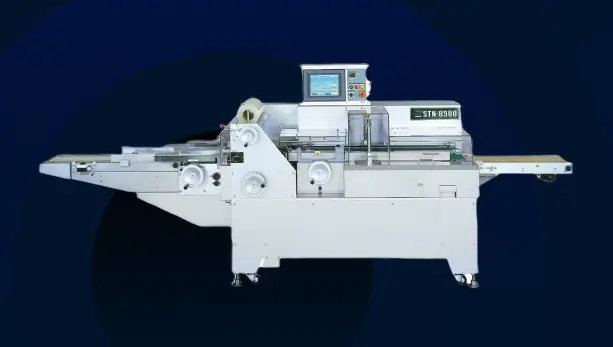
The Omori STN-8500 Series Stretch Wrapper is specifically designed to deliver high-speed tray overwrap with flexible changeovers, supporting a wide range of tray sizes and product types while maintaining throughput and pack quality. For decision makers, the ROI is simple: shaving 10–15 minutes off each changeover across multiple SKU switches per shift can translate to thousands of extra saleable packs per week.
Scaling Consideration #4: Film Loading, Film Width & Tension
Film is one of your most visible ongoing costs. As meat packaging grows, so do film expenses. Your stretch wrapper should help you control material usage, not just burn through rolls faster.
Fast, Safe Film Loading
Look for features like:
- Front-loading to simplify changeovers
- Large-diameter film roll capacity to reduce the number of changeovers per shift
Every avoided stop keeps your upstream operations in sync with packaging.
Matching Film Width to Tray Families
Oversized film rolls are silent margin killers. A scalable stretch wrapper should:
- Support multiple film widths and make it easy to switch between them
- Allow fine control of cut length and overhang per recipe
- Maintain consistent stretch ratios so you can confidently use thinner gauges or more sustainable films
This level of control becomes even more important as plants look to transition toward more recyclable or lower-impact films, such as PE-based options, while preserving performance.
Intelligent Tension Management
Too much tension: cracked trays, split corners, and crushed foam
Too little tension: loose packs, wrinkles, and leakers
Servo-driven film feeds and closed-loop tension control help the wrapper automatically balance these forces across different tray loads and film specs. That not only improves appearance but also reduces rework and waste.
How Omori Helps Meat Processors Scale with Confidence
Omori’s stretch wrappers are designed with one assumption: your protein lines are running hard. From wings to pork chops and premium steaks, the equipment has to:
- Keep throughput high and predictable
- Make changeovers fast and repeatable
- Use film intelligently and efficiently
- Maintain consistent, retail-ready pack quality
If you’re looking at meat packaging machines to scale your stretch wrapping capacity, the question isn’t just “How fast can it run?” but “How reliably can it keep up with the real world of protein production?” A question Omori experts can help you answer! Fill out the form below to get the conversation started.
Get Our FREE Checklist: Scaling Stretch Wrappers for Protein Production
Download our easy-to-follow checklist for increasing protein production with your meat packaging, and see how it improves profitability for your business.
Contact Us
Have questions? Our team of customer care experts are standing by to help craft an efficient solution for your business. Complete the form below and an Omori representative will be in touch.
U.S. Facility
775 Atlanta South Parkway
Suite 300
College Park, GA
30349
Local: 770-913-7883
Canada Facility
28 Simpson Rd
Bolton, ON
L7E 1G9
Local: 905-857-7880
Toll Free: 1-888-379-4742
CONTACT SALES
CONTACT PARTS
CONTACT SERVICE
CONTACT CUSTOMER SERVICE
August 2026
Most food processors and manufacturers rely on a simple manual step for padding trays before packaging meats, proteins, fruits, vegetables, etc. While this process appears straightforward, it introduces hidden costs that often go unnoticed across the packaging operation
As production demands increase and consistency becomes more critical, many processors are discovering that manual tray preparation can quietly become a bottleneck, when a more efficient pre-padded tray solution is available.
Understanding the operational impact of this step helps processors identify opportunities to improve efficiency and packaging consistency.
Labor Demands in Manual Tray Padding
Manually inserting absorbent pads into trays requires dedicated labor. Employees must handle trays, align pads correctly, and maintain pace with upstream product flow. In high volume operations this task often requires multiple employees across different shifts making sure inventory levels are maintained.
This dependency on labor, especially for a task that does not directly add value to the product, is the biggest inefficiency and contributor to unnecessary cost.
Facilities that rely on manual tray padding may frequently experience:
- increased labor costs
- difficulty maintaining staffing levels
- slower line preparation
- inconsistent workflow
When staffing levels fluctuate, tray preparation can quickly fall behind production demands. This forces downstream packaging equipment to slow down or stop while operators catch up.
Inconsistent Pad Placement
Another challenge with manual tray padding is consistency. Pads may shift, fold, or sit slightly off-center depending on how quickly trays are assembled.
Even minor inconsistencies can impact the final package quality. Improper positioning may lead to wrinkled film, poor absorption performance, or compromised product presentation during handling and transport.
Common issues include
- uneven pad alignment
- wrinkled film during wrapping
- inconsistent product presentation
- increased package rejects
Consistency is critical in food packaging. Small inconsistencies upstream can lead to quality issues further down the line.
Production Slowdowns at the Packaging Line
Efficient Packaging lines depend on smooth upstream preparation. When trays are not ready as when product arrives, the entire operation is disrupted.
These delays often occur during peak production periods. when high-speed equipment is most sensitive to interruptions.
Operations relying on manual tray padding may encounter:
- packaging line interruptions
- reduced throughput
- increased operator intervention
- higher downtime
While individual delays may last only seconds, repeated interruptions throughout a shift can significantly impact total production output.
The Efficiency of Pre-Padded Trays
Complex packaging lines often rely heavily on operator expertise to manage different product formats. When settings change between shifts or operators interpret adjustments differently, packaging performance becomes inconsistent.
Flexible tray lidding technology reduces this dependency by standardizing the sealing process.
Automated controls and repeatable machine settings allow operators to select the appropriate configuration for each SKU while maintaining consistent performance. This approach helps eliminate the trial-and-error adjustments that often accompany frequent format changes.
Building Packaging Flexibility in the Line
Modern food processing requires packaging systems that can evolve with product portfolios. Equipment that supports only a narrow range of formats quickly becomes a limitation as product offerings expand.
Flexible tray lidding machines provide processors with the ability to introduce new SKUs without redesigning the entire packaging line. By supporting multiple tray types and sealing materials, the equipment allows production teams to adapt quickly to market demands.
Omori’s Lid Sealer by Frimaq is designed with this flexibility in mind. The system supports rapid format changes while maintaining stable sealing performance and consistent packaging quality.
Packaging Technology That Keeps Pace with your Product Line
SKU complexity is unlikely to decrease. As consumer preferences continue to evolve, processors must manage more packaging formats while maintaining operational efficiency.
Tray lidding technology that supports flexibility allows manufacturers to respond to these changes without sacrificing line performance.
Omori North America provides the Lid Sealer by Frimaq, a tray lidding solution engineered to handle diverse packaging formats while maintaining seal integrity and production speed. By combining flexibility and machine design, we help processors manage growing product portfolios with confidence.
Interested in exploring how Omori can help your operation manage SKU complexity while maintaining reliable packaging performance? Fill out the form below and our team will connect with you.